Fraction Calculator (Add, Subtract, Multiply & Divide Fractions)
Calculate fractions instantly and get step-by-step solutions. Supports addition, subtraction, multiplication, division, and simplification.
Common Fraction Conversions
Related Calculators
How to Calculate Fractions — Step by Step
Each operation has a clear method. Follow the steps exactly and you'll never get it wrong.
How to Add Fractions (1/2 + 3/4)
- Step 1 — Find the LCD: Denominators are 2 and 4. LCD = 4.
- Step 2 — Convert to equivalent fractions: 1/2 = 2/4 (multiply top & bottom by 2). 3/4 stays as 3/4.
- Step 3 — Add numerators: 2/4 + 3/4 = (2+3)/4 = 5/4
- Step 4 — Simplify: GCD(5,4) = 1 → already simplified. As mixed number: 1 1/4
How to Subtract Fractions (3/10 − 1/20)
- Step 1 — Find the LCD: LCD of 10 and 20 = 20.
- Step 2 — Convert: 3/10 = 6/20. 1/20 stays.
- Step 3 — Subtract numerators: 6/20 − 1/20 = 5/20
- Step 4 — Simplify: GCD(5,20) = 5 → 5/20 = 1/4
How to Multiply Fractions (2/3 × 1/16)
- Step 1 — Multiply numerators: 2 × 1 = 2
- Step 2 — Multiply denominators: 3 × 16 = 48
- Step 3 — Simplify: 2/48 → GCD(2,48) = 2 → 1/24
Tip: you can cross-simplify before multiplying — divide 2 (numerator) and 16 (denominator) by 2 first: get 1/3 × 1/8 = 1/24.
How to Divide Fractions (3/4 ÷ 1/2)
- Step 1 — Keep the first fraction
- Step 2 — Flip the second (reciprocal): 1/2 → 2/1
- Step 3 — Multiply: 3/4 × 2/1 = 6/4
- Step 4 — Simplify: GCD(6,4) = 2 → 3/2 = 1 1/2
Common Fraction Addition Results
Quick answers for the most searched fraction addition problems.
| Problem | Answer | Decimal | Mixed Number |
|---|---|---|---|
| 1/2 + 1/3 | 5/6 | 0.833 | — |
| 1/2 + 1/4 | 3/4 | 0.75 | — |
| 1/2 + 1/6 | 2/3 | 0.667 | — |
| 1/3 + 1/4 | 7/12 | 0.583 | — |
| 2/3 + 1/4 | 11/12 | 0.917 | — |
| 3/4 + 1/2 | 5/4 | 1.25 | 1 1/4 |
| 3/4 + 1/3 | 13/12 | 1.083 | 1 1/12 |
| 2/3 + 1/3 | 1 | 1.0 | — |
| 1/4 + 3/8 | 5/8 | 0.625 | — |
| 5/6 + 1/3 | 7/6 | 1.167 | 1 1/6 |
Comparing Fractions — Which Is Bigger?
To compare fractions, convert to the same denominator or use cross-multiplication.
| Fraction A | vs | Fraction B | Result | Decimals |
|---|---|---|---|---|
| 1/2 | vs | 1/3 | 1/2 > 1/3 | 0.500 vs 0.333 |
| 2/3 | vs | 3/4 | 2/3 < 3/4 | 0.667 vs 0.750 |
| 3/5 | vs | 2/3 | 3/5 < 2/3 | 0.600 vs 0.667 |
| 5/8 | vs | 3/5 | 5/8 > 3/5 | 0.625 vs 0.600 |
| 7/10 | vs | 3/4 | 7/10 < 3/4 | 0.700 vs 0.750 |
| 4/7 | vs | 5/9 | 4/7 > 5/9 | 0.571 vs 0.556 |
| 2/5 | vs | 3/8 | 2/5 > 3/8 | 0.400 vs 0.375 |
What Is a Fraction Calculator?
A fraction calculator is a tool that helps you perform operations on fractions without manual steps. It automatically finds the least common denominator (LCD), simplifies results, and shows answers as fractions, mixed numbers, and decimals.
How to Use the Fraction Calculator — Step by Step
- 1Enter Fraction 1 — Type the numerator (top number) and denominator (bottom number).
- 2Enter Fraction 2 — Fill in the same fields for the second fraction.
- 3Choose Operation — Select Add, Subtract, Multiply, or Divide.
- 4Click Calculate — Instantly see the simplified fraction, mixed number, and decimal.
Example Calculations
| Operation | Input | Result | Decimal | Mixed Number |
|---|---|---|---|---|
| Addition | 1/2 + 3/4 | 5/4 | 1.25 | 1 1/4 |
| Subtraction | 3/10 − 1/20 | 1/4 | 0.25 | — |
| Multiplication | 2/3 × 1/16 | 1/24 | 0.0417 | — |
| Division | 3/4 ÷ 1/2 | 3/2 | 1.5 | 1 1/2 |
Understanding Fractions
What Are Fractions?
A fraction represents a part of a whole. It is written as two numbers separated by a line: the numerator (top) tells how many parts you have, and the denominator (bottom) tells how many equal parts make up the whole. For example, 3/4 means 3 out of 4 equal parts.
Improper Fractions and Mixed Numbers
An improper fraction has a numerator larger than or equal to its denominator, such as 7/4. This can be converted to a mixed number: 7/4 = 1 3/4 (one whole and three quarters). To convert, divide the numerator by the denominator -- the quotient becomes the whole number and the remainder becomes the new numerator.
Simplifying Fractions
A fraction is in its simplest form when the numerator and denominator share no common factor other than 1. To simplify, find the Greatest Common Divisor (GCD) of both numbers and divide each by it. For example, 8/12: GCD(8, 12) = 4, so 8/12 = 2/3.
Types of Fractions
- 3/4Proper Fraction — numerator is smaller than denominator. Value is between 0 and 1. Examples: 1/2, 3/4, 7/8.
- 5/3Improper Fraction — numerator is greater than or equal to denominator. Value is ≥ 1. Examples: 5/3, 7/4, 11/6.
- 1⅔Mixed Number — whole number combined with a proper fraction. Examples: 1 2/3, 2 3/4, 5 1/8. Convert to improper: multiply whole × denominator, add numerator.
- 2/4Equivalent Fractions — different fractions with the same value. 1/2 = 2/4 = 3/6 = 4/8. Multiply or divide both parts by the same number.
- 1/7Unit Fraction — numerator is always 1. Examples: 1/2, 1/3, 1/7, 1/11. Each unit fraction is the reciprocal of a whole number.
Why Use This Calculator?
- Education — Students can check homework and practice fraction problems.
- Cooking & Recipes — Scale ingredients with fractional measurements instantly.
- Construction — Convert fractional inch measurements quickly.
- Finance — Useful for ratios and bond pricing expressed in fractions.
Example Scenario — Jack Using the Calculator
Jack is baking cookies. The recipe calls for 3/4 cup sugar, but he wants to make 2/3 of the recipe. He enters 3/4 and 2/3 into the calculator, selects Multiply, and gets 1/2 cup sugar. Instead of doing manual steps, Jack gets the answer instantly and avoids mistakes.
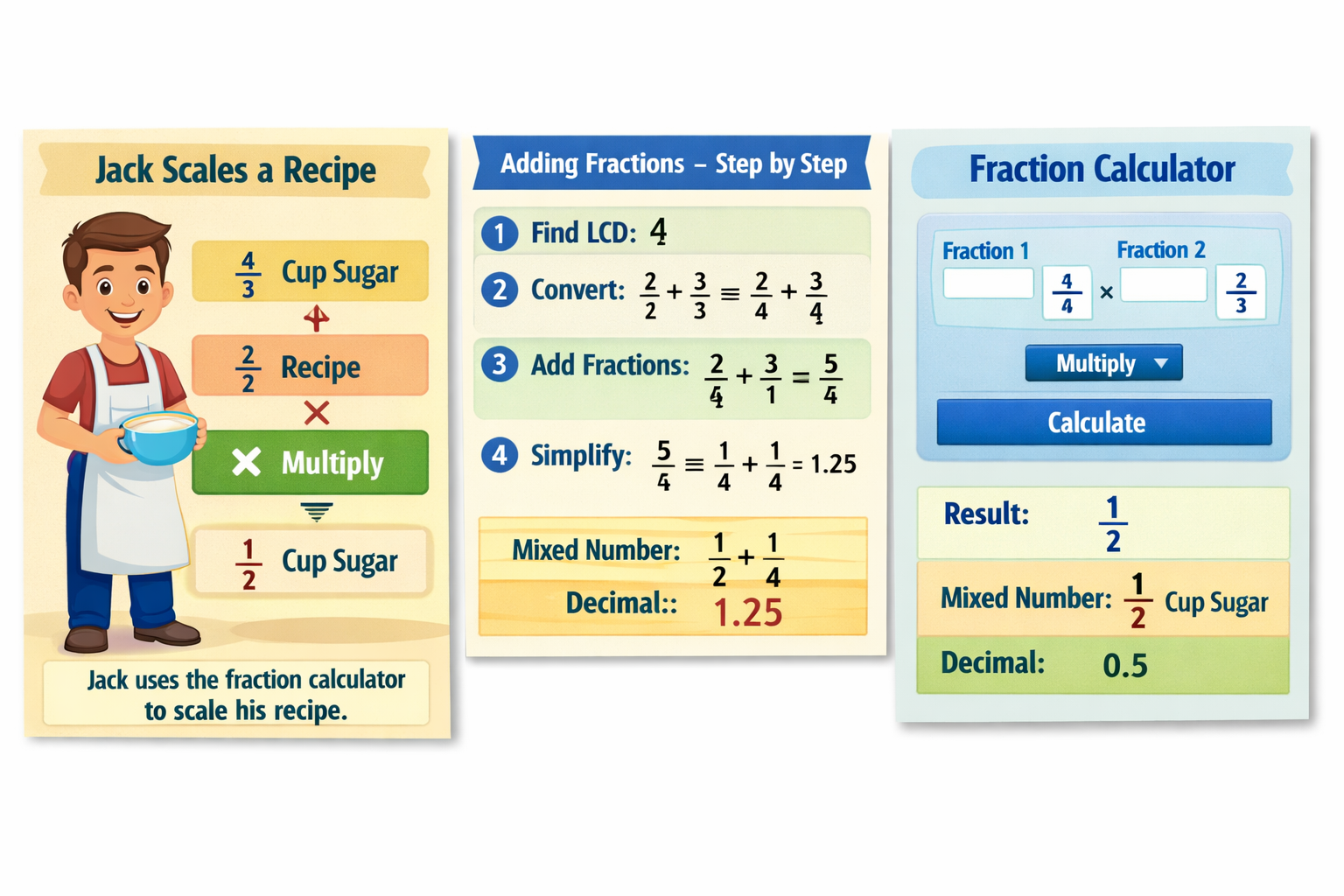
Jack scales a recipe — step-by-step fraction multiplication visualized
Fraction Operation Formulas
Addition
Subtraction
Multiplication
Division
Division by a fraction is the same as multiplying by its reciprocal. To divide by c/d, flip c/d to get d/c, then multiply.
Worked Example: Add 2/3 + 3/4
Let us add the fractions 2/3 and 3/4 step by step:
Step 1: Find a common denominator. The denominators are 3 and 4. The least common denominator (LCD) is 12.
Step 2: Convert each fraction. 2/3 = 8/12 (multiply numerator and denominator by 4). 3/4 = 9/12 (multiply numerator and denominator by 3).
Step 3: Add the numerators: 8 + 9 = 17. Keep the common denominator: 17/12.
Step 4: Simplify if possible. 17 and 12 share no common factors, so 17/12 is already in simplest form.
Step 5: As a mixed number: 17/12 = 1 5/12.
Using the cross-multiplication formula: (2*4 + 3*3) / (3*4) = (8 + 9) / 12 = 17/12. The result matches.
Common Fraction-Decimal Equivalents
| Fraction | Decimal | Percentage |
|---|---|---|
| 1/2 | 0.5 | 50% |
| 1/3 | 0.333... | 33.33% |
| 2/3 | 0.667... | 66.67% |
| 1/4 | 0.25 | 25% |
| 3/4 | 0.75 | 75% |
| 1/5 | 0.2 | 20% |
| 1/8 | 0.125 | 12.5% |
| 3/8 | 0.375 | 37.5% |
| 5/8 | 0.625 | 62.5% |
| 7/8 | 0.875 | 87.5% |
| 1/10 | 0.1 | 10% |
| 1/6 | 0.167... | 16.67% |
Fraction Tips and Tricks
- Always simplify your answer. After performing any operation, divide the numerator and denominator by their GCD to get the simplest form.
- Never divide by zero. A fraction with a denominator of 0 is undefined. Make sure your denominators are always non-zero.
- For addition and subtraction, find the LCD first. Using the least common denominator (rather than just multiplying denominators) keeps numbers smaller and easier to work with.
- For multiplication, simplify before multiplying. Cancel common factors between any numerator and any denominator (cross-cancellation) before multiplying across.
- To divide fractions, multiply by the reciprocal. Flip the second fraction and then multiply. This is the "keep, change, flip" method.
- Convert to decimals to verify. If you are unsure of your answer, convert both the original fractions and your result to decimals to check.
Real-World Applications of Fractions
Cooking and Baking
Recipe scaling relies heavily on fraction arithmetic. If a recipe calls for 2/3 cup of flour and you want to make 1.5 times the batch, you multiply: (2/3) × (3/2) = 6/6 = 1 cup. Professional bakers work in baker's percentages where every ingredient is expressed as a fraction of the flour weight. A standard bread dough might be 100% flour, 65% water (65/100 = 13/20), 2% salt, and 1% yeast. When you scale from 500g flour to 750g, you multiply each fraction by the scaling factor: 13/20 of 750g = 487.5g water.
Construction and Carpentry
Carpenters measure in feet and inches using fractions down to 1/16 inch precision. If you need to cut a board 5 feet 7 3/8 inches long and remove 2 1/4 inches, you subtract mixed numbers: 7 3/8 - 2 1/4 = 7 3/8 - 2 2/8 = 5 1/8 inches (converting 1/4 to 2/8 to get a common denominator). Building codes often specify dimensions in fractions: stud spacing at 16 inches on center, drywall thickness of 5/8 inch, or rafter slopes expressed as rise/run fractions like 5/12 (a 5-inch rise for every 12 inches of horizontal run).
Music Theory
Musical rhythm is fundamentally based on fractions. A quarter note is 1/4 of a whole note, an eighth note is 1/8, and a sixteenth note is 1/16. When you see a time signature like 3/4, it means three quarter-notes per measure. Adding rhythms requires fraction addition: a quarter note (1/4) plus an eighth note (1/8) equals 3/8 of a whole note. Tempo markings also use fractions—"half note = 60 BPM" means the half note (1/2) gets the beat at 60 beats per minute, so a whole note lasts 2 seconds and a quarter note lasts 0.5 seconds.
Financial Calculations
Stock prices in the U.S. traded in fractions (eighths and sixteenths) until 2001. Even today, bond prices quote in 32nds: a price of "99-16" means 99 and 16/32 = 99.5% of par value. If you own a $10,000 bond trading at 99-16, its market value is $10,000 × (99 + 16/32)/100 = $9,950. Profit-sharing agreements often divide ownership in fractions: if three partners own 1/2, 1/3, and 1/6 of a business respectively, and the company earns $120,000, their shares are $60,000, $40,000, and $20,000 (multiplying $120k by each fraction).
Pharmacology and Medicine
Nurses calculate drug dosages using fractions daily. If a doctor prescribes 3/4 of a 20mg tablet and the patient needs the dose twice daily, that's 2 × (3/4 × 20mg) = 2 × 15mg = 30mg per day. IV drip rates combine fractions with time: if a 500mL bag must infuse over 6 hours using tubing that delivers 15 drops per mL, the drip rate is (500 × 15) / (6 × 60) drops per minute = 7,500 / 360 = 125/6 ≈ 20.8 drops/min. Precision matters—miscalculating a fraction can lead to under- or over-dosing.
Advanced Fraction Techniques
Complex Fractions
A complex fraction has a fraction in the numerator, denominator, or both. Example: (2/3) / (5/7). To simplify, multiply the numerator by the reciprocal of the denominator: (2/3) × (7/5) = 14/15. Real-world case: If a car travels 2/3 of a mile in 5/7 of an hour, its speed is (2/3) / (5/7) = 14/15 miles per hour ≈ 0.933 mph. Another method: multiply both parts by the LCD of all sub-fractions. For (1/2 + 1/3) / (1/4), the LCD of 2, 3, and 4 is 12. Multiply top and bottom by 12: [12(1/2 + 1/3)] / [12(1/4)] = (6 + 4) / 3 = 10/3.
Continued Fractions
Mathematicians express irrational numbers as continued fractions. The golden ratio φ ≈ 1.618 equals 1 + 1/(1 + 1/(1 + 1/...)). Truncating this infinite series gives rational approximations: 1/1, 2/1, 3/2, 5/3, 8/5, 13/8—notice these are consecutive Fibonacci ratios. The fraction 8/5 = 1.6 approximates φ within 2%. Engineers use continued fractions to find simple gear ratios: if you need a 3.14159 ratio (≈ π), the continued fraction gives you 22/7 (error 0.04%) or 355/113 (error 0.000008%). This beats trial-and-error decimal rounding.
Algebraic Fractions
When variables appear in fractions, the same arithmetic rules apply. To add (x/3) + (2x/5), find the LCD (15): (5x/15) + (6x/15) = 11x/15. To simplify (x² - 4) / (x + 2), factor the numerator: (x - 2)(x + 2) / (x + 2). Cancel the common (x + 2) factor to get x - 2 (valid when x ≠ -2, since division by zero is undefined). Real application: If a water tank fills at a rate of 1/x tanks per hour and empties at 1/(x+2) tanks per hour, the net fill rate is 1/x - 1/(x+2) = [(x+2) - x] / [x(x+2)] = 2 / [x(x+2)] tanks per hour.
Egyptian Fractions
Ancient Egyptians wrote all fractions (except 2/3) as sums of unit fractions (fractions with numerator 1). For example, 3/4 = 1/2 + 1/4, and 5/6 = 1/2 + 1/3. The greedy algorithm finds these: to express 7/15, take the largest unit fraction less than 7/15 (that's 1/3 = 5/15), subtract to get 2/15, then take the largest unit fraction less than 2/15 (that's 1/8 = 1.875/15... too big, so try 1/9 = 1.67/15... still too big, try 1/10 = 1.5/15). Actually, 1/3 + 1/8 = 40/120 + 15/120 = 55/120 ≠ 7/15. The correct decomposition is 7/15 = 1/3 + 1/15 (verify: 5/15 + 1/15 = 6/15 ≠ 7/15). This shows the challenge—there's usually more than one valid decomposition. Modern use: Computer science employs unit fraction representations in rational approximation algorithms.
Common Fraction Mistakes and How to Avoid Them
❌ Mistake #1: Adding Fractions Across (The "Add Straight Across" Error)
Wrong: 1/2 + 1/3 = 2/5 (adding numerators and denominators separately)
Right: 1/2 + 1/3 = 3/6 + 2/6 = 5/6
Why it fails: Fractions must have a common denominator before you can add the numerators. Adding 1/2 + 1/3 means "half of a pizza plus a third of a pizza"—you can't just add unlike pieces. Convert to sixths first: three sixths plus two sixths equals five sixths. Real impact: A student who uses this method on a test will get 2/5 = 0.4 instead of the correct 5/6 ≈ 0.833, a 52% error.
❌ Mistake #2: Canceling Across Addition
Wrong: (x + 2) / (x + 3) = 2/3 (canceling the x's)
Right: The fraction cannot be simplified further unless you factor out common terms (and there are none here).
Why it fails: You can only cancel common factors, not common terms. Factors are multiplied together; terms are added. Test with x = 1: left side is 3/4 = 0.75, right side is 2/3 ≈ 0.667—not equal. Cancellation only works in multiplication: (2 × 7) / (3 × 7) = 2/3 because 7 is a common factor you can divide out.
❌ Mistake #3: Forgetting to Flip When Dividing
Wrong: (2/3) ÷ (4/5) = 8/15 (multiplying straight across)
Right: (2/3) ÷ (4/5) = (2/3) × (5/4) = 10/12 = 5/6
Why it fails: Division by a fraction means "how many of the divisor fit into the dividend." Dividing by 4/5 is the same as multiplying by its reciprocal 5/4. Think: "How many 4/5-cup servings can I get from 2/3 cup?" The answer is (2/3) / (4/5) = 5/6 servings, not 8/15. Practical check: the result 5/6 ≈ 0.833 is larger than the dividend 2/3 ≈ 0.667, which makes sense because dividing by a fraction less than 1 makes the result bigger.
❌ Mistake #4: Confusing Mixed Numbers and Improper Fractions
Wrong: 2 1/3 × 3 = 2 3/9 (multiplying the whole number by the numerator only)
Right: Convert to improper: 2 1/3 = 7/3, then 7/3 × 3 = 21/3 = 7
Why it fails: You must convert mixed numbers to improper fractions before multiplying or dividing. The mixed number 2 1/3 means 2 + 1/3 = 6/3 + 1/3 = 7/3. Alternatively, multiply the denominator by the whole number and add the numerator: (3 × 2) + 1 = 7, place over 3 to get 7/3. Real scenario: A recipe needs 2 1/3 cups flour per batch, you're making 3 batches—the total is 7 cups, not 2 3/9 ≈ 2.33 cups.
❌ Mistake #5: Not Simplifying the Final Answer
Incomplete: 6/9 (leaving the answer unsimplified)
Complete: 6/9 = 2/3 (dividing both numerator and denominator by 3)
Why it matters: In standardized tests and professional contexts, answers are expected in simplest form. Teachers mark 6/9 as incomplete even if numerically correct. Find the GCD of 6 and 9: factors of 6 are (1, 2, 3, 6), factors of 9 are (1, 3, 9), so GCD = 3. Divide: 6 ÷ 3 = 2, 9 ÷ 3 = 3, giving 2/3. Simplified fractions are easier to understand: 2/3 of a pizza is clearer than 6/9.
Converting Between Forms: Fractions, Decimals, and Percentages
Fraction to Decimal
Divide the numerator by the denominator. For 3/8: 3 ÷ 8 = 0.375. Some fractions produce repeating decimals: 1/3 = 0.333... (the 3 repeats infinitely), and 2/7 = 0.285714285714... (the block "285714" repeats). Long division reveals the pattern. Shortcut for ninths: 1/9 = 0.111..., 2/9 = 0.222..., up to 8/9 = 0.888... For elevenths: 1/11 = 0.090909..., 2/11 = 0.181818..., and so on. Knowing these patterns helps you recognize fractions from their decimal equivalents instantly.
Decimal to Fraction
For a terminating decimal like 0.625, count the decimal places (three), so write it as 625/1000, then simplify: GCD(625, 1000) = 125, giving 5/8. For a repeating decimal like 0.454545..., let x = 0.454545..., multiply by 100 (since the repeating block has 2 digits): 100x = 45.454545... Subtract the original equation: 100x - x = 45.454545... - 0.454545..., so 99x = 45, thus x = 45/99 = 5/11 after simplifying by 9. This algebraic trick works for any repeating decimal.
Fraction to Percentage
Convert the fraction to a decimal, then multiply by 100. For 7/8: 7 ÷ 8 = 0.875, so 0.875 × 100 = 87.5%. Alternatively, multiply the fraction by 100/1 first: (7/8) × (100/1) = 700/8 = 87.5. Direct method: 3/4 = 75% (since 3/4 × 100 = 300/4 = 75). Benchmark percentages to memorize: 1/4 = 25%, 1/2 = 50%, 3/4 = 75%, 1/5 = 20%, 1/10 = 10%. These anchor your mental math for nearby fractions.
Percentage to Fraction
Write the percentage as a fraction over 100, then simplify. 45% = 45/100 = 9/20 (dividing by GCD of 5). For a decimal percentage like 12.5%, write 12.5/100, multiply numerator and denominator by 10 to clear the decimal: 125/1000 = 1/8 after simplifying by 125. Tricky case: 33.33% suggests 1/3 (since 1/3 = 0.3333... = 33.33...%). If you see a repeating decimal percentage, recognize common fractions: 16.67% ≈ 1/6, 66.67% ≈ 2/3, 83.33% ≈ 5/6.
Fraction Word Problems: Step-by-Step Solutions
Problem 1: Sharing Pizza
Question: A pizza is cut into 8 equal slices. Maria eats 3 slices, John eats 2 slices, and Sarah eats 1 slice. What fraction of the pizza remains?
Solution:
- Total slices = 8
- Slices eaten = 3 + 2 + 1 = 6
- Slices remaining = 8 - 6 = 2
- Fraction remaining = 2/8 = 1/4 (simplified)
Answer: 1/4 of the pizza remains (25%)
Problem 2: Garden Planning
Question: A gardener plants flowers in 2/5 of a garden and vegetables in 1/3 of the garden. What fraction of the garden has been planted?
Solution:
- Add the two fractions: 2/5 + 1/3
- Find LCD of 5 and 3 = 15
- Convert: 2/5 = 6/15, 1/3 = 5/15
- Add: 6/15 + 5/15 = 11/15
Answer: 11/15 of the garden is planted (≈73.3%), leaving 4/15 unplanted
Problem 3: Recipe Scaling
Question: A cookie recipe calls for 3/4 cup sugar. You want to make 2/3 of the recipe. How much sugar do you need?
Solution:
- Multiply: (3/4) × (2/3)
- Multiply numerators: 3 × 2 = 6
- Multiply denominators: 4 × 3 = 12
- Result: 6/12 = 1/2 (simplified by dividing by 6)
Answer: You need 1/2 cup of sugar
Problem 4: Time Management
Question: A student spends 1/6 of their day sleeping, 1/4 of their day in school, and 1/8 of their day on homework. What fraction of the day is spent on other activities?
Solution:
- Add fractions: 1/6 + 1/4 + 1/8
- Find LCD of 6, 4, and 8 = 24
- Convert: 1/6 = 4/24, 1/4 = 6/24, 1/8 = 3/24
- Add: 4/24 + 6/24 + 3/24 = 13/24
- Remaining: 24/24 - 13/24 = 11/24
Answer: 11/24 of the day (≈45.8%) is spent on other activities
Industry-Specific Fraction Applications
Engineering and Manufacturing
Mechanical drawings specify tolerances in fractions of an inch: a shaft might be dimensioned as 1.250 ± 1/64 inch, meaning the diameter must be between 1.234 and 1.266 inches (since 1/64 ≈ 0.0156). Machinists use fractional drill bit sizes: #1 = 0.228", #2 = 0.221", continuing in 1/64" increments for larger bits. Gear ratios are fractions: a 3:1 ratio (3/1) means the input shaft turns 3 times for every 1 turn of the output shaft. If you chain two gear sets—first 5:2, second 3:1—the combined ratio is (5/2) × (3/1) = 15/2 = 7.5:1.
Photography
Shutter speeds are fractions of a second: 1/125, 1/250, 1/500, doubling each step. Each doubling halves the light exposure (one "stop"). If a scene is correctly exposed at 1/125 second and you change to 1/500 (which is 1/125 × 1/4), you've reduced light by two stops, requiring you to open the aperture by two stops (e.g., from f/8 to f/4) to compensate. Aperture f-numbers are also fractions: f/2.8 means the lens opening diameter is the focal length divided by 2.8. An f/2.8 lens on a 100mm focal length has a 100/2.8 ≈ 35.7mm diameter opening.
Land Surveying
Property boundaries in the U.S. Public Land Survey System divide land into sections (1 square mile = 640 acres). A parcel described as "the NE 1/4 of the SW 1/4 of Section 12" means: take the southwest quarter of Section 12 (640 × 1/4 = 160 acres), then take the northeast quarter of that (160 × 1/4 = 40 acres). Multiple fractions multiply: (1/4) × (1/4) = 1/16 of the section = 40 acres. Surveyors also measure slopes as fractions: a 1:20 slope (1/20 = 0.05) means a 5% grade—1 foot of vertical rise for every 20 feet of horizontal distance.
Sports Analytics
Baseball batting average is a fraction: hits / at-bats. A player with 75 hits in 250 at-bats has a 75/250 = 3/10 = 0.300 average (written as ".300"). Basketball free-throw percentage works the same way: 18 makes out of 24 attempts = 18/24 = 3/4 = 0.750 or 75%. On-base percentage (OBP) combines hits, walks, and hit-by-pitch divided by plate appearances—if a player has 85 hits, 35 walks, and 5 HBP in 400 plate appearances, OBP = (85 + 35 + 5) / 400 = 125/400 = 5/16 = 0.3125 or .313 in baseball notation.
Most Searched Fraction Problems — Instant Answers
The fraction calculations people search for most often, with decimal and mixed-number results.
Adding Fractions
Subtracting Fractions
Multiplying Fractions
Dividing Fractions
Simplifying Fractions
Equivalent Fractions Chart
Two fractions are equivalent when they represent the same value. Multiply both numerator and denominator by the same number. For example, 1/2 = 2/4 = 3/6 = 4/8.
| Fraction | ×2 | ×3 | ×4 | ×5 | ×6 | ×8 | ×10 | ×12 |
|---|---|---|---|---|---|---|---|---|
| 1/2 | 2/4 | 3/6 | 4/8 | 5/10 | 6/12 | 8/16 | 10/20 | 12/24 |
| 1/3 | 2/6 | 3/9 | 4/12 | 5/15 | 6/18 | 8/24 | 10/30 | 12/36 |
| 2/3 | 4/6 | 6/9 | 8/12 | 10/15 | 12/18 | 16/24 | 20/30 | 24/36 |
| 1/4 | 2/8 | 3/12 | 4/16 | 5/20 | 6/24 | 8/32 | 10/40 | 12/48 |
| 3/4 | 6/8 | 9/12 | 12/16 | 15/20 | 18/24 | 24/32 | 30/40 | 36/48 |
| 1/5 | 2/10 | 3/15 | 4/20 | 5/25 | 6/30 | 8/40 | 10/50 | 12/60 |
| 2/5 | 4/10 | 6/15 | 8/20 | 10/25 | 12/30 | 16/40 | 20/50 | 24/60 |
| 3/5 | 6/10 | 9/15 | 12/20 | 15/25 | 18/30 | 24/40 | 30/50 | 36/60 |
| 4/5 | 8/10 | 12/15 | 16/20 | 20/25 | 24/30 | 32/40 | 40/50 | 48/60 |
| 1/6 | 2/12 | 3/18 | 4/24 | 5/30 | 6/36 | 8/48 | 10/60 | 12/72 |
| 1/8 | 2/16 | 3/24 | 4/32 | 5/40 | 6/48 | 8/64 | 10/80 | 12/96 |
| 3/8 | 6/16 | 9/24 | 12/32 | 15/40 | 18/48 | 24/64 | 30/80 | 36/96 |
Fractions of a Number — Quick Reference
What is 1/2 of 24? What is 3/4 of 60? Use this table for instant answers to the most common fraction-of-a-number questions.
| Fraction | of 10 | of 12 | of 20 | of 24 | of 30 | of 36 | of 48 | of 60 | of 100 |
|---|---|---|---|---|---|---|---|---|---|
| 1/2 | 5 | 6 | 10 | 12 | 15 | 18 | 24 | 30 | 50 |
| 1/3 | 3.3 | 4 | 6.7 | 8 | 10 | 12 | 16 | 20 | 33.3 |
| 2/3 | 6.7 | 8 | 13.3 | 16 | 20 | 24 | 32 | 40 | 66.7 |
| 1/4 | 2.5 | 3 | 5 | 6 | 7.5 | 9 | 12 | 15 | 25 |
| 3/4 | 7.5 | 9 | 15 | 18 | 22.5 | 27 | 36 | 45 | 75 |
| 1/5 | 2 | 2.4 | 4 | 4.8 | 6 | 7.2 | 9.6 | 12 | 20 |
| 2/5 | 4 | 4.8 | 8 | 9.6 | 12 | 14.4 | 19.2 | 24 | 40 |
| 1/6 | 1.7 | 2 | 3.3 | 4 | 5 | 6 | 8 | 10 | 16.7 |
| 1/8 | 1.3 | 1.5 | 2.5 | 3 | 3.8 | 4.5 | 6 | 7.5 | 12.5 |
| 3/8 | 3.8 | 4.5 | 7.5 | 9 | 11.3 | 13.5 | 18 | 22.5 | 37.5 |
| 1/10 | 1 | 1.2 | 2 | 2.4 | 3 | 3.6 | 4.8 | 6 | 10 |
| 7/8 | 8.8 | 10.5 | 17.5 | 21 | 26.3 | 31.5 | 42 | 52.5 | 87.5 |
Ordering Fractions from Least to Greatest
To compare fractions: convert to a common denominator (or to decimals), then sort. Below are the most commonly compared fractions in order.
| Fraction | Decimal | Percent | Where it falls |
|---|---|---|---|
| 1/10 | 0.100 | 10% | Far below half |
| 1/8 | 0.125 | 12.5% | Far below half |
| 1/6 | 0.167 | 16.7% | Below half |
| 1/5 | 0.200 | 20% | Below half |
| 1/4 | 0.250 | 25% | One quarter |
| 1/3 | 0.333 | 33.3% | One third |
| 3/8 | 0.375 | 37.5% | Near half |
| 2/5 | 0.400 | 40% | Near half |
| 1/2 | 0.500 | 50% | Exactly half |
| 3/5 | 0.600 | 60% | Above half |
| 5/8 | 0.625 | 62.5% | Above half |
| 2/3 | 0.667 | 66.7% | Two thirds |
| 3/4 | 0.750 | 75% | Three quarters |
| 4/5 | 0.800 | 80% | Above 3/4 |
| 7/8 | 0.875 | 87.5% | Near whole |
| 9/10 | 0.900 | 90% | Near whole |
Common Fraction Problem Answers
Quick answers to frequently searched fraction calculations. Use the calculator above for any custom problem.
Addition
| Problem | Answer | Mixed Number | Decimal |
|---|---|---|---|
| 1/2 + 1/3 | 5/6 | — | 0.8333 |
| 1/3 + 1/4 | 7/12 | — | 0.5833 |
| 2/9 + 5/12 | 23/36 | — | 0.6389 |
| 14/99 + 2/9 | 4/11 | — | 0.3636 |
| 3/4 + 1/2 | 5/4 | 1 1/4 | 1.25 |
| 2/5 + 3/7 | 29/35 | — | 0.8286 |
| 5/6 + 1/4 | 13/12 | 1 1/12 | 1.0833 |
Subtraction
| Problem | Answer | Decimal |
|---|---|---|
| 1/2 − 1/3 | 1/6 | 0.1667 |
| 8/15 − 2/5 | 2/15 | 0.1333 |
| 2/3 − 1/4 | 5/12 | 0.4167 |
| 3/4 − 2/5 | 7/20 | 0.35 |
| 5/6 − 1/3 | 1/2 | 0.5 |
| 7/8 − 3/4 | 1/8 | 0.125 |
Division
| Problem | Answer | Mixed Number | Decimal |
|---|---|---|---|
| 5/2 ÷ 8/9 | 45/16 | 2 13/16 | 2.8125 |
| 2/3 ÷ 4/5 | 5/6 | — | 0.8333 |
| 3/4 ÷ 1/2 | 3/2 | 1 1/2 | 1.5 |
| 5/6 ÷ 2/3 | 5/4 | 1 1/4 | 1.25 |
| 7/8 ÷ 3/4 | 7/6 | 1 1/6 | 1.1667 |
| 1/3 ÷ 2/7 | 7/6 | 1 1/6 | 1.1667 |
Step-by-Step Fraction Examples
Exact answers for the most commonly searched fraction calculations.
1/2 + 3/4 as a fraction
1/2 + 3/4 = 5/4 = 1¼ = 1.25
Step 2: 1/2 = 2/4
Step 3: 2/4 + 3/4 = 5/4
Mixed: 1 remainder 1 → 1 1/4 | Decimal: 1.25
3/10 − 1/20 as a fraction
3/10 − 1/20 = 1/4 = 0.25
Step 2: 3/10 = 6/20
Step 3: 6/20 − 1/20 = 5/20 = 1/4
Decimal: 0.25 | Check: 0.3 − 0.05 = 0.25 ✓
2/3 × 1/16 as a fraction
2/3 × 1/16 = 1/24 ≈ 0.0417
Step 2: Multiply denominators: 3 × 16 = 48
Step 3: Simplify 2/48: GCD(2,48) = 2 → 1/24
Decimal: 1 ÷ 24 = 0.041667
This comes up in recipes: 2/3 of a 1/16 cup = 1/24 cup (about 2 teaspoons).
1/9 × c + 1/2 = 7/5 — solving for c
This is an equation, not just a fraction problem. c = 81/10 = 8.1
1/9 × c = 14/10 − 5/10 = 9/10
c = (9/10) ÷ (1/9) = (9/10) × 9 = 81/10 = 8.1
Fraction as a Decimal — Common Examples
To convert any fraction to a decimal, divide the numerator by the denominator. Some fractions produce terminating decimals (like 1/4 = 0.25) while others produce repeating decimals (like 1/3 = 0.333…). Below are the most searched fractions as decimals with full explanations.
1/7 as a Decimal
1 ÷ 7 = 0.142857142857… — a repeating decimal where the block "142857" repeats infinitely. This is written as 0.142857.
Rounded to 4 decimal places: 0.1429
As a percentage: 14.29%
Why it repeats: When you do long division of 1 by 7, the remainders cycle through 1, 3, 2, 6, 4, 5 before returning to 1 — creating the 6-digit repeat. The fraction 1/7 is a well-known example of a cyclic number.
1/9 as a Decimal
1 ÷ 9 = 0.111… — the digit 1 repeats forever. Written as 0.1.
Rounded to 4 decimal places: 0.1111
As a percentage: 11.11%
Pattern shortcut: All ninths follow this rule — 2/9 = 0.222…, 3/9 = 0.333… (= 1/3), up to 8/9 = 0.888…, and 9/9 = 1.
1/11 as a Decimal
1 ÷ 11 = 0.090909… — the two-digit block "09" repeats. Written as 0.09.
Rounded to 4 decimal places: 0.0909
As a percentage: 9.09%
Elevenths pattern: 2/11 = 0.18, 3/11 = 0.27, 4/11 = 0.36 — the two-digit block increases by 9 each time (09, 18, 27, 36, 45, 54, 63, 72, 81, 90).
1/12 as a Decimal
1 ÷ 12 = 0.08333… — the digit 3 repeats after an initial non-repeating part. Written as 0.0833.
Rounded to 4 decimal places: 0.0833
As a percentage: 8.33%
Real-world use: One month is 1/12 of a year ≈ 0.0833 years. A monthly interest rate of 1/12 of the annual rate uses this conversion.
1/15 as a Decimal
1 ÷ 15 = 0.06666… — the digit 6 repeats. Written as 0.06.
Rounded to 4 decimal places: 0.0667
As a percentage: 6.67%
1/16 as a Decimal
1 ÷ 16 = 0.0625 — a terminating decimal (no repeating).
As a percentage: 6.25%
Real-world use: Carpenters and machinists use 1/16 inch precision. 1/16" = 0.0625 inches exactly. Sixteenths terminate because 16 = 2⁴ (a power of 2), and powers of 2 always produce terminating decimals.
1/20 as a Decimal
1 ÷ 20 = 0.05 — a terminating decimal.
As a percentage: 5%
Why it terminates: 20 = 4 × 5 = 2² × 5¹. Fractions terminate when the denominator's only prime factors are 2 and 5. Since 20 qualifies, 1/20 = 0.05 exactly.
1/25 as a Decimal
1 ÷ 25 = 0.04 — a terminating decimal.
As a percentage: 4%
2/7 as a Decimal
2 ÷ 7 = 0.285714285714… — repeating block "285714".
Rounded to 4 decimal places: 0.2857
As a percentage: 28.57%
Note: All sevenths (1/7, 2/7, 3/7, 4/7, 5/7, 6/7) use the same six digits (142857) in a different starting position — a unique property of 7 as a denominator.
3/7 as a Decimal
3 ÷ 7 = 0.428571428571… — repeating block "428571".
Rounded to 4 decimal places: 0.4286
As a percentage: 42.86%
Quick Reference: Fractions as Decimals
| Fraction | Decimal | % | Type |
|---|---|---|---|
| 1/7 | 0.142857… | 14.29% | Repeating (6-digit) |
| 2/7 | 0.285714… | 28.57% | Repeating (6-digit) |
| 3/7 | 0.428571… | 42.86% | Repeating (6-digit) |
| 4/7 | 0.571428… | 57.14% | Repeating (6-digit) |
| 5/7 | 0.714285… | 71.43% | Repeating (6-digit) |
| 6/7 | 0.857142… | 85.71% | Repeating (6-digit) |
| 1/9 | 0.1111… | 11.11% | Repeating (1-digit) |
| 2/9 | 0.2222… | 22.22% | Repeating (1-digit) |
| 1/11 | 0.0909… | 9.09% | Repeating (2-digit) |
| 2/11 | 0.1818… | 18.18% | Repeating (2-digit) |
| 3/11 | 0.2727… | 27.27% | Repeating (2-digit) |
| 1/12 | 0.08333… | 8.33% | Repeating (1-digit) |
| 1/15 | 0.06666… | 6.67% | Repeating (1-digit) |
| 1/16 | 0.0625 | 6.25% | Terminating |
| 1/20 | 0.05 | 5% | Terminating |
| 1/25 | 0.04 | 4% | Terminating |